
How ADEZI translates relative valuations, risk and liquidity into portfolio positioning.
A business can remain strong while its investment appeal changes. As its price rises or falls, so does the return available from owning it. Across a market, those changing terms call for a considered response.
At ADEZI, stance expresses how conservatively or aggressively we intend to position the portfolio. It connects the attractiveness of the market with the balance of risk we are willing to carry.
The process starts with valuations: we assess the market and set a target stance. We then calculate the stance of the portfolio we already own, using the size and risk of each holding. Comparing the two shows where positioning needs to change. Stance and liquidity multipliers adjust the room available in individual positions; the investment case and price determine whether to use that room. This is how a market assessment becomes a practical allocation decision.
Read valuation in context
We compare relevant Indian and global indices with their own ten-year valuation averages. Price-to-earnings and price-to-book measures show what investors are paying relative to earnings and book value. The Indian comparison spans broad-market and size-based indices; the global comparison includes US equities, emerging markets and China. Together, they help identify where prices reflect demanding expectations and where the terms may be more attractive.
A historical average is a reference, rather than a price the market must return to. Changes in the businesses within an index, earnings quality and the calculation method still matter. Global comparisons broaden the context; selected Indian indices carry the weights used to calculate the target for the Indian portfolio.
Set the target before measuring the portfolio
The valuation assessment leads to one of five stances: Aggressive, Opportunistic, Balanced, Safer or Defensive. Each has a numerical target for the balance of portfolio risk. For example, Balanced targets a 60% conservative and 40% aggressive mix after allowing for risk. This describes the character of the holdings; it does not mean 60% in cash and 40% in equities.
When opportunities are attractive, an aggressive stance allows more room for qualifying investments with higher structural risk. A defensive stance favours a more conservative mix and less room for additions to higher-risk holdings. The stance sets our approach to positioning, without depending on a prediction of the next market move.
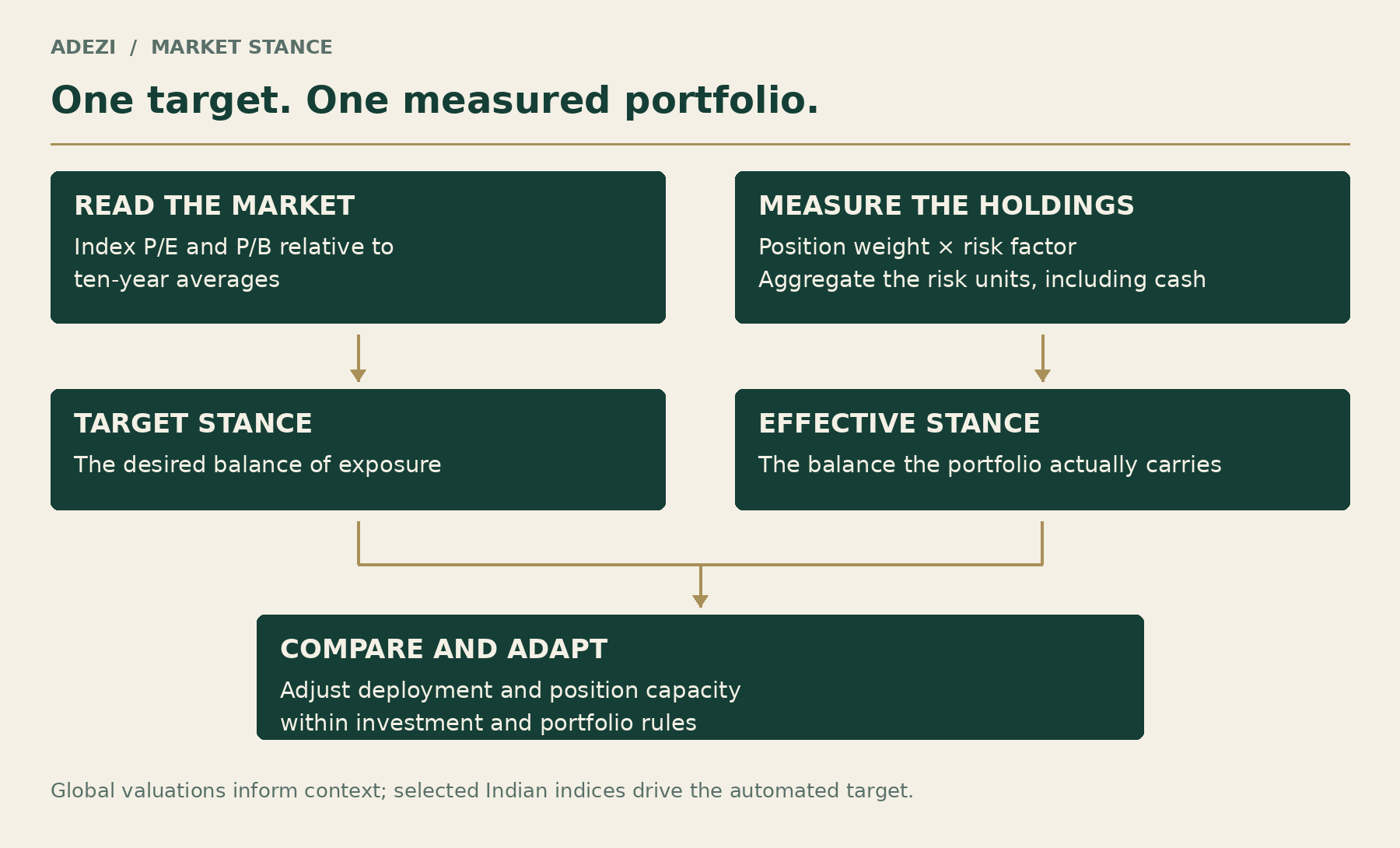
The target expresses the intended positioning. The effective stance measures the holdings. Comparing the two makes the required adjustment visible.
Calculate the stance the holdings actually carry
We calculate the portfolio’s effective stance from what it holds. For each position, its share of the portfolio is multiplied by the factor assigned to its structural risk category. These weighted contributions, called risk units, are added together on the conservative and aggressive sides. Cash and equivalents are included. The resulting balance tells us how the portfolio is actually positioned.
The target tells us where we want to be. The effective stance tells us where we are. Comparing them shows whether the portfolio is more aggressive or more conservative than intended. This calculation also captures position size: a small higher-risk holding has a different influence from a large one.
Translate stance into position capacity
The sizing rules translate that assessment into room for individual positions. The ADEZI Score category and structural risk set base buy capacity: the starting limit for building a holding. A liquidity multiplier adjusts it for ease of trading. A stance multiplier then adjusts it for market conditions and the holding’s risk category. Wider portfolio limits still apply.
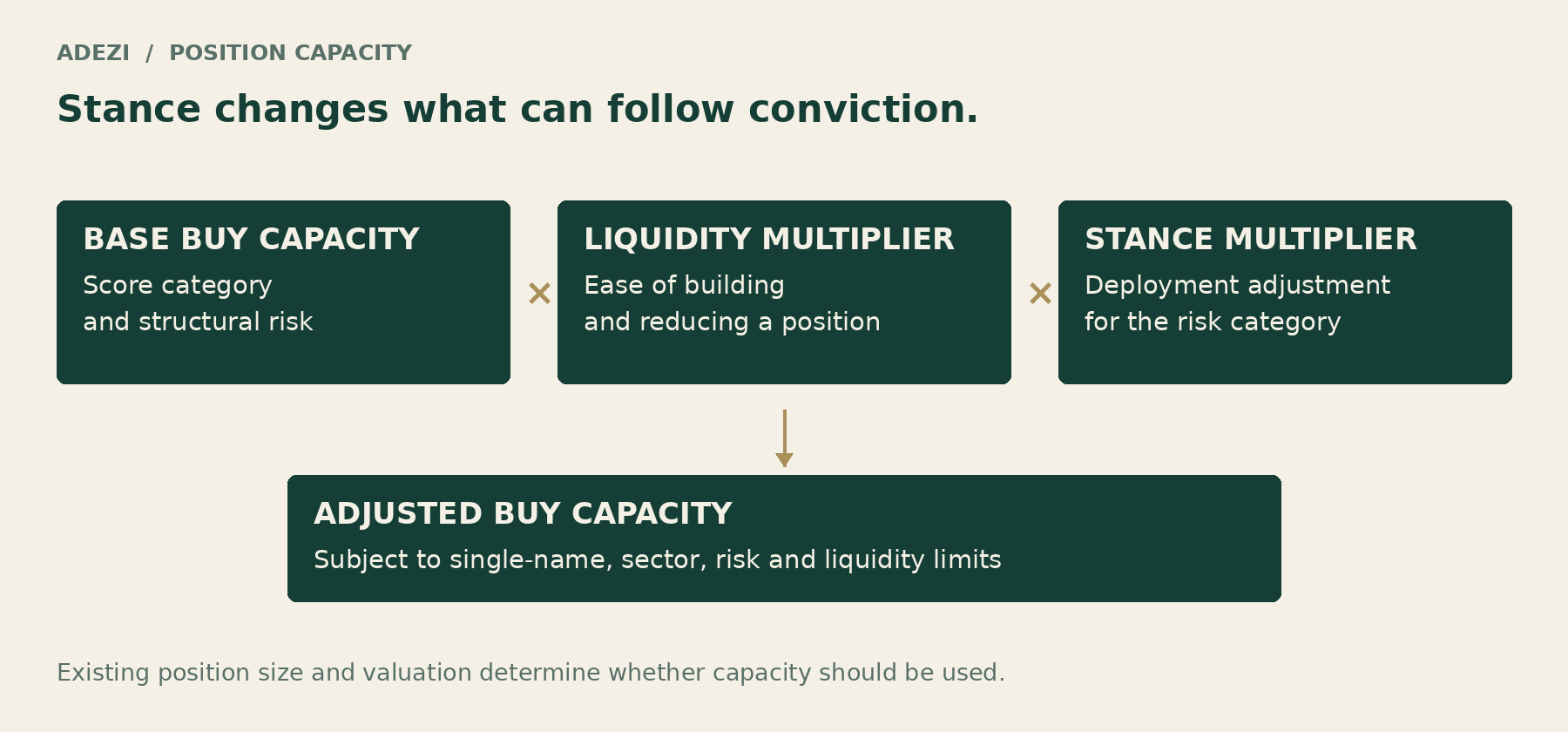
Liquidity adjusts buying capacity. Effective portfolio stance is calculated from position weights and risk factors; these are related controls with distinct roles.
A more aggressive stance can increase the room available in qualifying higher-risk investments; a defensive stance can reduce it. We still check the investment case, today’s valuation, what we already own and the portfolio’s concentration before adding. Available capacity is permission to consider an addition, rather than an instruction to make one.
Adapt as the opportunity changes
Consider a market where share prices rise faster than earnings and valuations become more demanding. Businesses we own may remain strong, while the returns available from adding to them become less attractive. A more defensive stance can slow further deployment and reduce the room for higher-risk positions, even when their business cases remain intact.
If valuations later become more favourable, a more opportunistic stance creates room for investments that continue to pass the research and valuation tests. We can change buying pace and the balance of risk as the opportunity changes. Repositioning follows the rules for each holding, rather than requiring the whole portfolio to change at once.
Stance keeps the process connected: assess the market, set the target, measure the portfolio, and adjust the room available for each holding. It allows greater participation when opportunities justify it and greater restraint when they offer less. The market sets the terms. We adapt our positioning through a process we can explain, measure and revisit.