
Consider a business that looks increasingly interesting. Customers are returning. A new facility promises a step up in output. Earnings could rise meaningfully over the next few years, yet the share price still reflects a difficult past.
The temptation is to move quickly. But an attractive idea leaves several decisions unresolved. How much of the recovery is already in the price? What happens if it arrives late? How much capital should depend on it? And what evidence would make us change our minds?
The ADEZI Framework follows an idea through these decisions. Each stage tests something the previous stage cannot settle on its own.
First understand the setting
Before studying the company in isolation, we consider the market in which capital is being deployed. Valuation conditions inform our stance, from defensive to aggressive, and influence deployment pace and portfolio exposure. A promising business can emerge in an expensive market. The opportunity deserves attention; the surrounding conditions still deserve restraint.
Then test the business
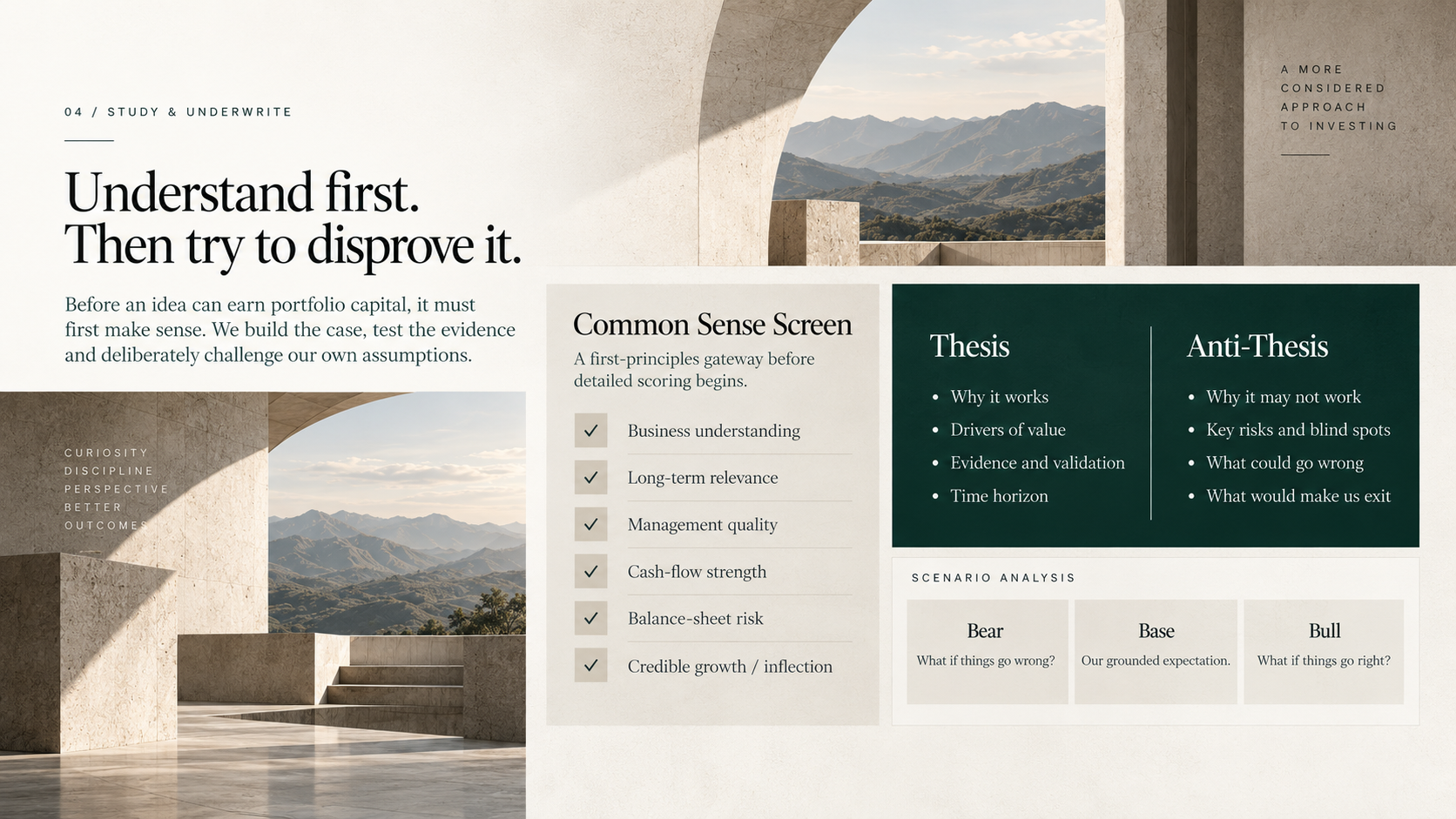
Our hypothetical company first faces a common-sense screen. Can we understand its economics? Is management credible? Does the business generate cash? Will the new facility create value after accounting for the capital it consumes? A growing order book is encouraging, but it cannot answer these questions.
We write the thesis and then deliberately build the anti-thesis. Perhaps demand has merely been brought forward. Perhaps stronger profits will be absorbed by receivables. Bear, base and bull scenarios show how the investment behaves if the recovery disappoints, proceeds reasonably or exceeds expectations. The idea now has conditions attached to it, including what would prove it wrong.
Give the whole investment case a shape
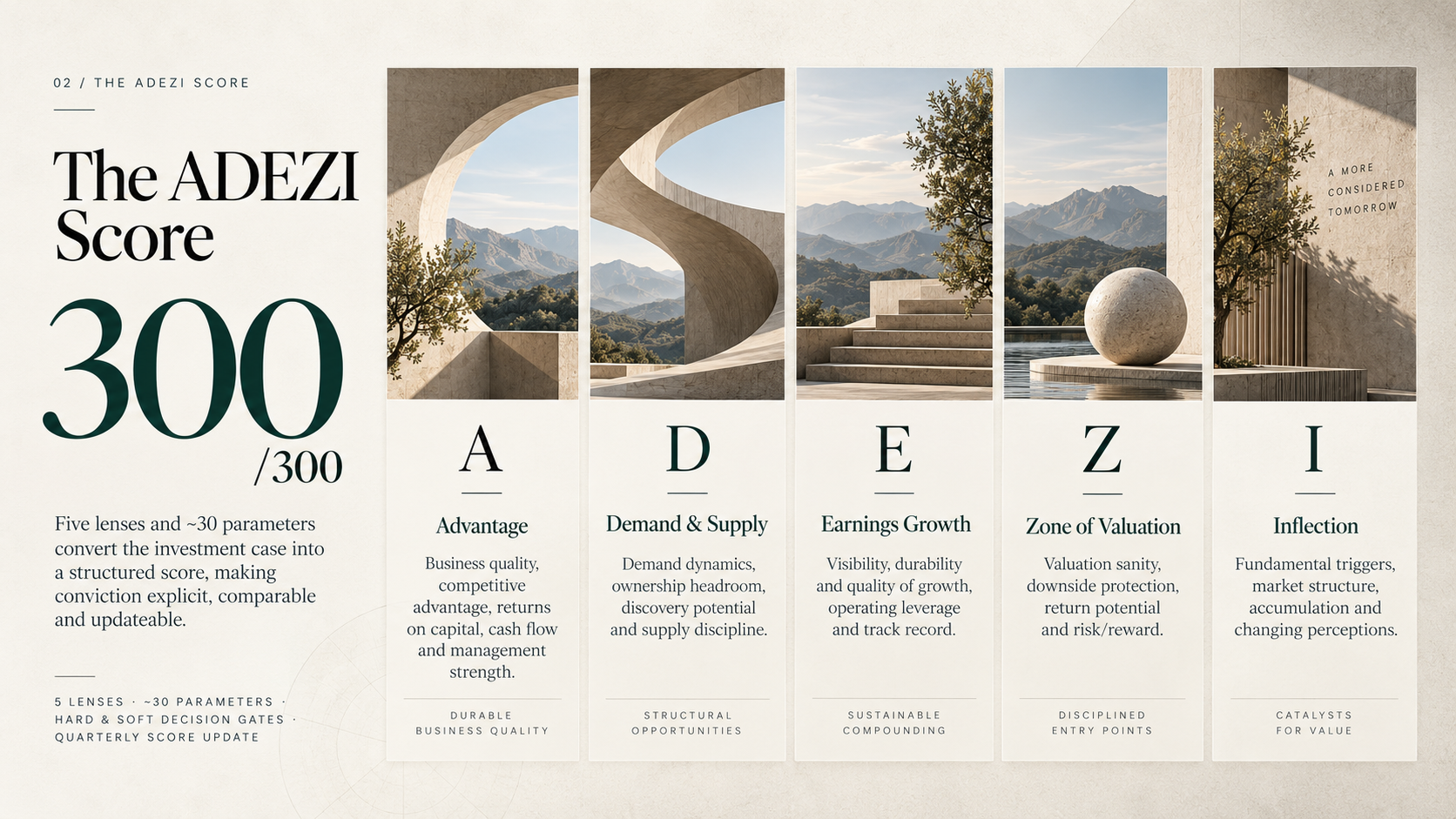
Research rarely delivers a uniformly attractive picture. Our company may have improving earnings and a reasonable valuation, but only a modest competitive advantage. Ownership could leave room for new institutional interest, while a large shareholder’s potential exit creates a supply overhang. These features need to be considered together.
The 300-point ADEZI Score organises that assessment through five lenses: Advantage, Demand and Supply, Earnings Growth, Zone of Valuation, and Inflection. It makes the sources of conviction visible, and exposes where the case remains weak. The number summarises judgment; it cannot remove the uncertainty within it. Serious governance concerns or failed mandatory conditions cannot be offset by strength elsewhere.
Decide how much the idea deserves
Suppose the business passes these tests. The next decision is consequential: how much should we own? An attractive investment can still be given an allocation that makes the portfolio fragile.
Structural risk is assessed separately. Debt, refinancing needs and earnings cyclicality do not disappear because a share looks cheap. Liquidity matters too: a position that is easy to build in calm conditions may be difficult to reduce under stress. Our company’s improving prospects may justify an investment, while its exposure to one customer industry and thin trading still argue for a measured size.
The allocation brings together the score, valuation, risk, liquidity and market stance, within limits on individual holdings and wider exposures. It also accounts for what is already owned. Several different companies may depend on the same recovery. A portfolio can contain many names and remain concentrated in one assumption.
By this point, “we like the business” has become a more complete judgment: we understand why it may work, what could undermine it, and how much capital can reasonably depend on our view.
Let the evidence change the decision

Now imagine the first quarter after purchase. The shares fall. Earnings disappoint. The facility is taking longer to ramp up than expected.
This is where the original work becomes useful. We revisit the assumptions: are orders delayed or cancelled? Is cash conversion holding up? Does the balance sheet provide time for the recovery to develop? A delay within the range already considered calls for a different response from evidence that the economics of the expansion were misunderstood.
Quarterly re-underwriting, and earlier review when necessary, brings the business case and portfolio decision back together. The score, valuation and allocation are reconsidered against fresh evidence. Market behaviour provides additional context. An intact thesis may warrant patience; a weakening case may call for a smaller position; a broken thesis requires an exit decision.
Success needs the same scrutiny. If the recovery arrives and the shares rise sharply, the business may become stronger while the prospective return becomes less attractive. The position may also grow beyond sensible limits. Holding, adding or trimming depends on the opportunity from today’s price, with tax and transaction costs considered before acting.
A process that leaves room to be wrong
The framework’s value lies in how the decisions connect. Market stance sets the context. Research establishes the case and its vulnerabilities. Scoring makes the assessment explicit. Risk and liquidity constrain the allocation. Review tests whether the reasons for owning the business still hold.
None of this guarantees a favourable outcome. It gives an investor a considered basis for committing capital, staying patient and changing course. When the future unfolds differently from expectations, there is something more useful to return to than the confidence felt on the day of purchase.