
Two businesses pass the research process. One is an established supplier with durable customer relationships, healthy cash flows and steady growth. The other is entering a larger market, with new capacity that could accelerate earnings. Both merit consideration. Their investment cases, and the uncertainties behind them, are different.
The allocation decision requires a consistent basis for comparing those cases. At ADEZI, research is translated into a weighted assessment, then connected to structural risk, liquidity, valuation and portfolio exposure. The result is a defined position stance: whether to initiate, add, hold, trim or exit, and within what limits.
Establish the case before assigning capital
A common-sense screen first tests business understanding, relevance, management credibility, cash generation and balance-sheet viability. Ideas that proceed are developed through a written thesis, an anti-thesis and bear, base and bull scenarios. This establishes the evidence, assumptions and failure conditions that the subsequent score must reflect.
Assess the investment through five lenses
The ADEZI Score evaluates factors within Advantage, Demand and Supply, Earnings Growth, Zone of Valuation, and Inflection. Each scored factor is rated from 0 to 3 and multiplied by its assigned weight. Weighted factor scores are summed within each lens; the five lens scores then combine into a total out of 300.
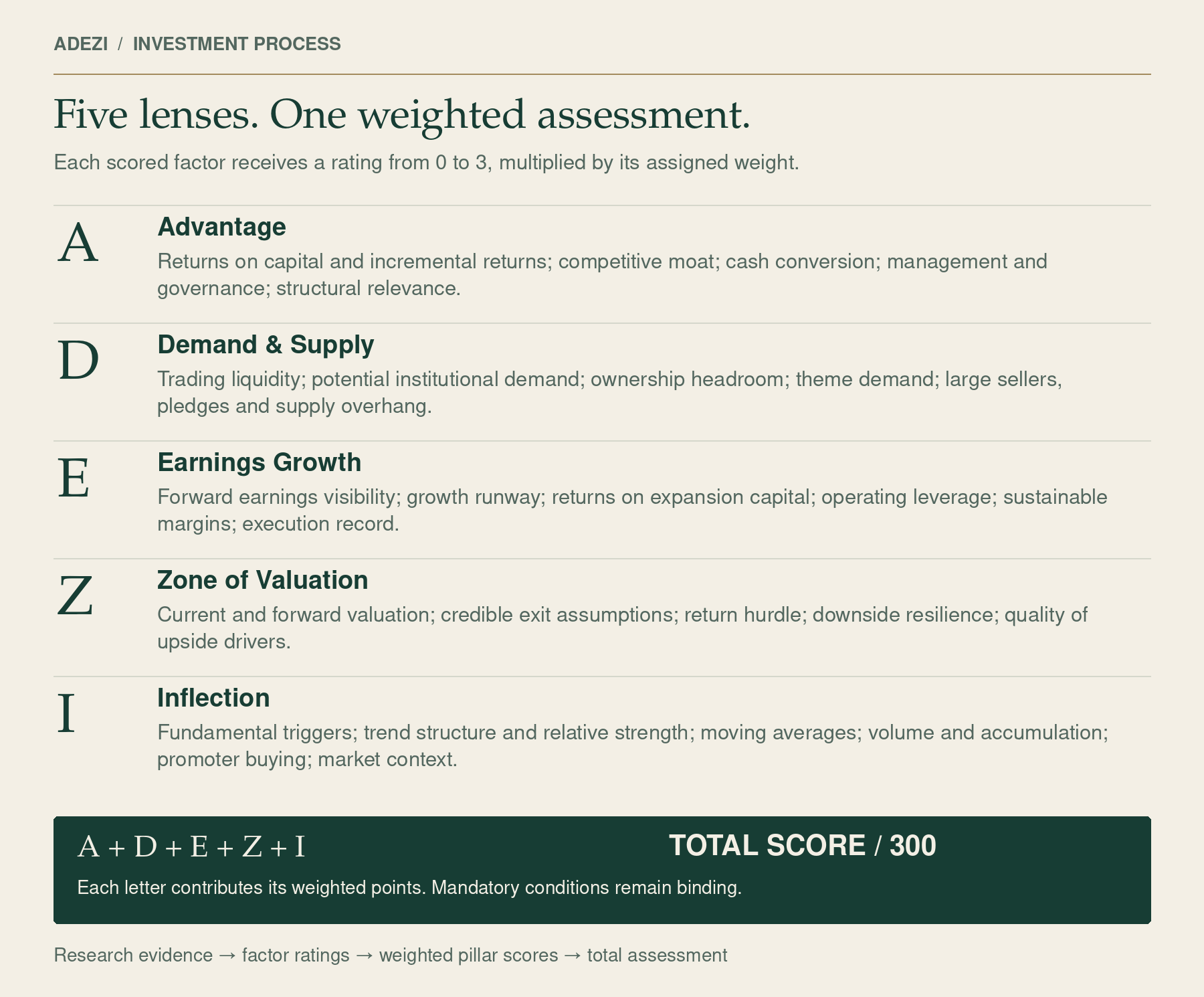
The weights ensure that factors contribute according to their assigned importance. The underlying parameters examine business economics, prospective earnings, valuation, ownership dynamics and evidence of change. Mandatory conditions remain binding: strength elsewhere cannot compensate for a failed essential requirement.
For our supplier, durable customer relationships must be supported by defensible advantages, sound returns on capital and cash conversion. For the expanding company, earnings growth must be examined alongside the returns on new capacity, margin sustainability and execution requirements. The same assessment makes these different sources of conviction comparable.
Translate conviction into position limits
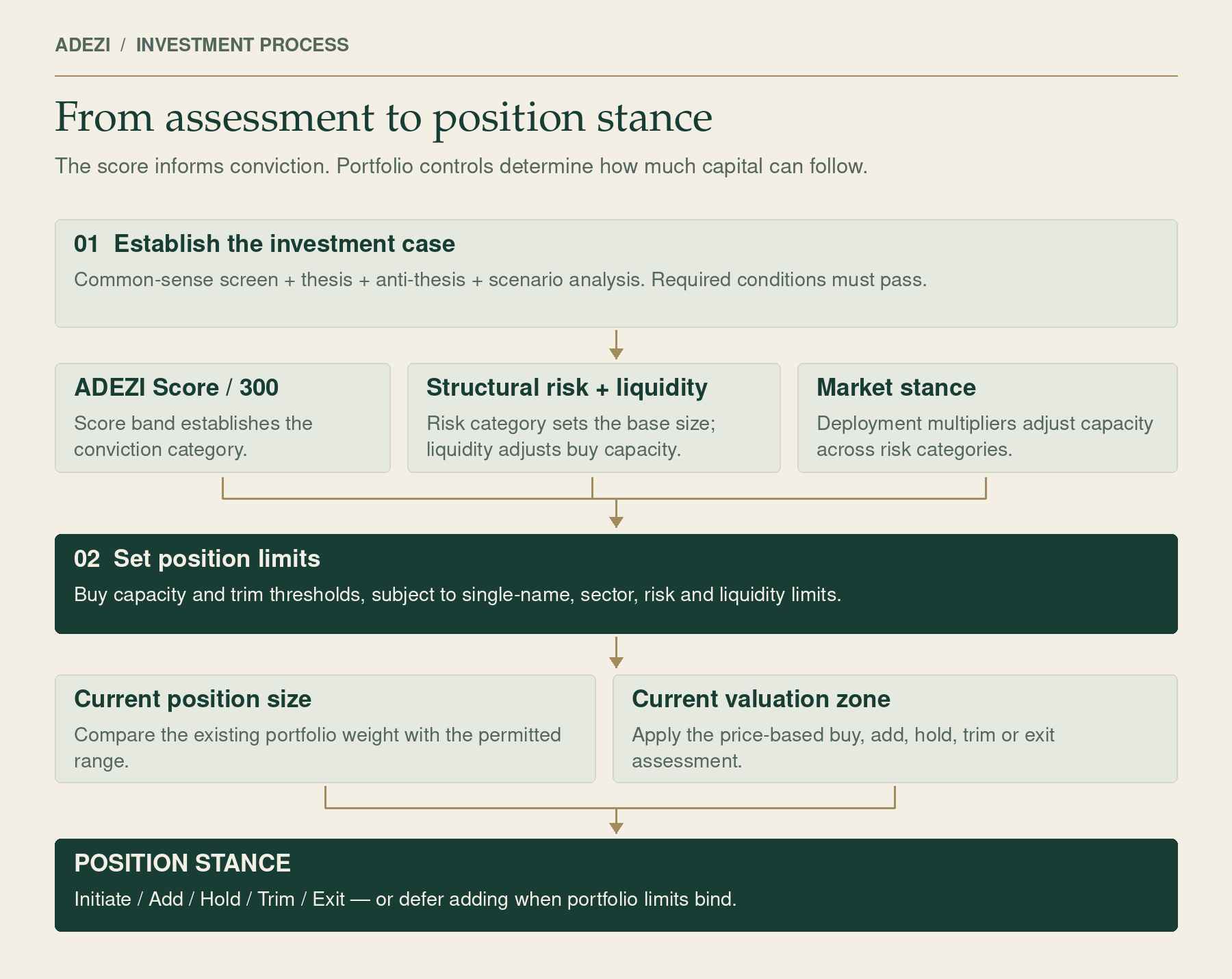
The total score places an investment within a conviction category. That category and the structural risk classification establish base buy capacity and trim thresholds. Liquidity adjusts buy capacity, while market stance applies deployment multipliers across risk categories. Single-name, sector, risk and liquidity limits constrain the resulting exposure.
Structural risk is assessed separately because an attractive price or strong score does not remove debt, refinancing pressure, earnings cyclicality or vulnerability under stress. Liquidity similarly determines whether a position can be built or reduced without unacceptable trading impact.
Determine the action from size and valuation
The existing position is compared with its permitted range. The current valuation zone then informs the action. An investment with capacity to grow may qualify for an addition at an attractive price; the same investment may warrant holding at a less favourable valuation. A position above its limits, or a valuation that materially reduces prospective returns, may require trimming.
This explains why the higher-scoring company need not receive the larger allocation. The expanding business may have stronger earnings potential but a higher structural risk classification or thinner liquidity. Those inputs can produce a smaller permitted position. The supplier’s more established economics may support greater exposure within the same system.
Keep the decision accountable to evidence
As results arrive, the assumptions behind the assessment are tested again. Capacity utilisation, margins, cash conversion, valuation and market behaviour can alter the relevant scores and position stance. Changes in conviction become traceable to changes in evidence.
The science of capital allocation is the discipline connecting these decisions. Research establishes the case. Weighted scoring makes the assessment explicit. Risk and liquidity govern capacity. Position size and valuation determine the action. Capital is committed through a process whose reasoning can be examined, challenged and revised.